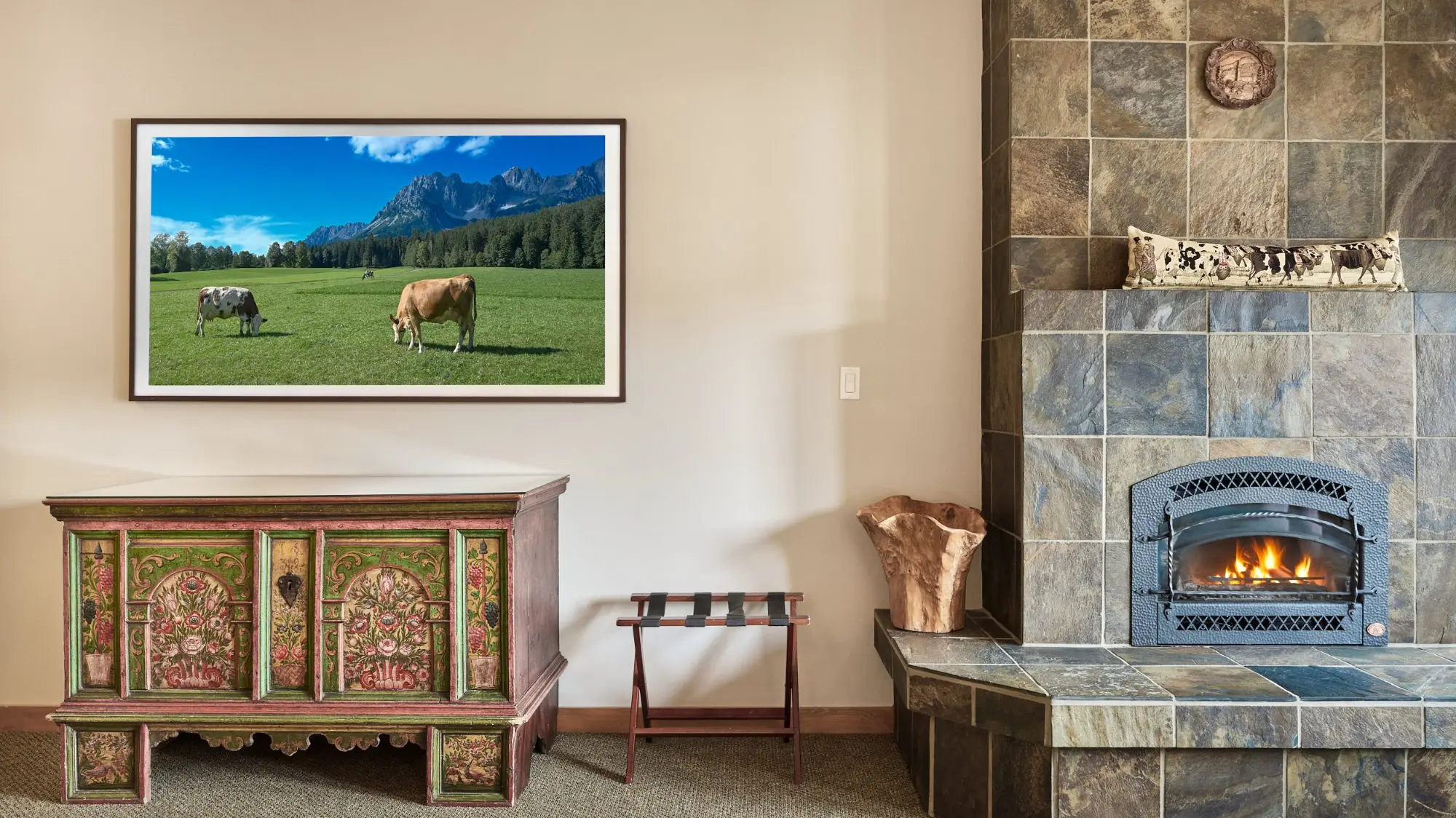
Rooms · one hotel, 3 styles
Leavenworth
Rooms · one hotel, 3 styles
Leavenworth
Authentic Bauernmöbel from Bavaria and Tirol. Genuine antique Truhen from the valleys of Tirol. The furniture in your room has a story. Here's how to read it.
Anne and Bob Smith spent years living and traveling in Bavaria and Tirol before they built Pension Anna in 1989. That time gave them something most hotel owners don't have: they knew what to look for. Painted beds, carved Schränke (wardrobes), pine tables, Herzlstühle (heart-back chairs). Authentic regional Bauernmöbel (farmer's furniture), brought back because they understood what made each piece worth having.
When Erika and Martin became owners in 2018, they continued that standard. The Landhaus Erika suites added genuine antique Truhen from the valleys of Tirol, each one an original 18th or 19th century piece. They also brought in traditional Alpine carpets imported from Germany, the kind found in old Bavarian inns. The detail matters, even when guests can't say exactly why.
Bauernmöbel, literally "farmer's furniture," was made by craftsmen in Alpine valleys for the families who lived there: sturdy, functional, and decorated in the style of the valley where it was built. Each craftsman worked within one regional tradition his whole life, which is why a Bad Tölz piece looks nothing like a Zillertal piece. That specificity is what you can't manufacture. It's what you notice in these rooms, even if you don't have a name for it yet.
Anne and Bob Smith built Pension Anna in 1989 with a clear idea of what it should look like. They studied the architecture and craft traditions of Bavaria and Tirol, and they sourced accordingly: painted beds, carved Schränke (wardrobes), pine tables, Herzlstühle (heart-back chairs). Mostly Kiefer (Scots pine) and Fichte (spruce), since hardwoods were expensive to bring into mountain valleys and most families couldn't afford them. These aren't antiques. Traditional craftsmen in Bavaria and Tirol still build Bauernmöbel for farmhouses today, using the same forms, materials, and techniques the craft has always used. That's what Anne and Bob sourced: the real thing, made the right way, for the purpose it was designed for.
Most of what you see is carved rather than painted. Painted Bauernmöbel required a specialist painter on top of the carpenter, and not every household could afford both. Most rooms at Pension Anna follow the carved tradition. The Loisachtal and Pinzgau rooms are the exception: fully painted environments where walls, furniture, and ceiling work together as a single decorative program, the way the most elaborate Alpine farmhouse interiors were done.
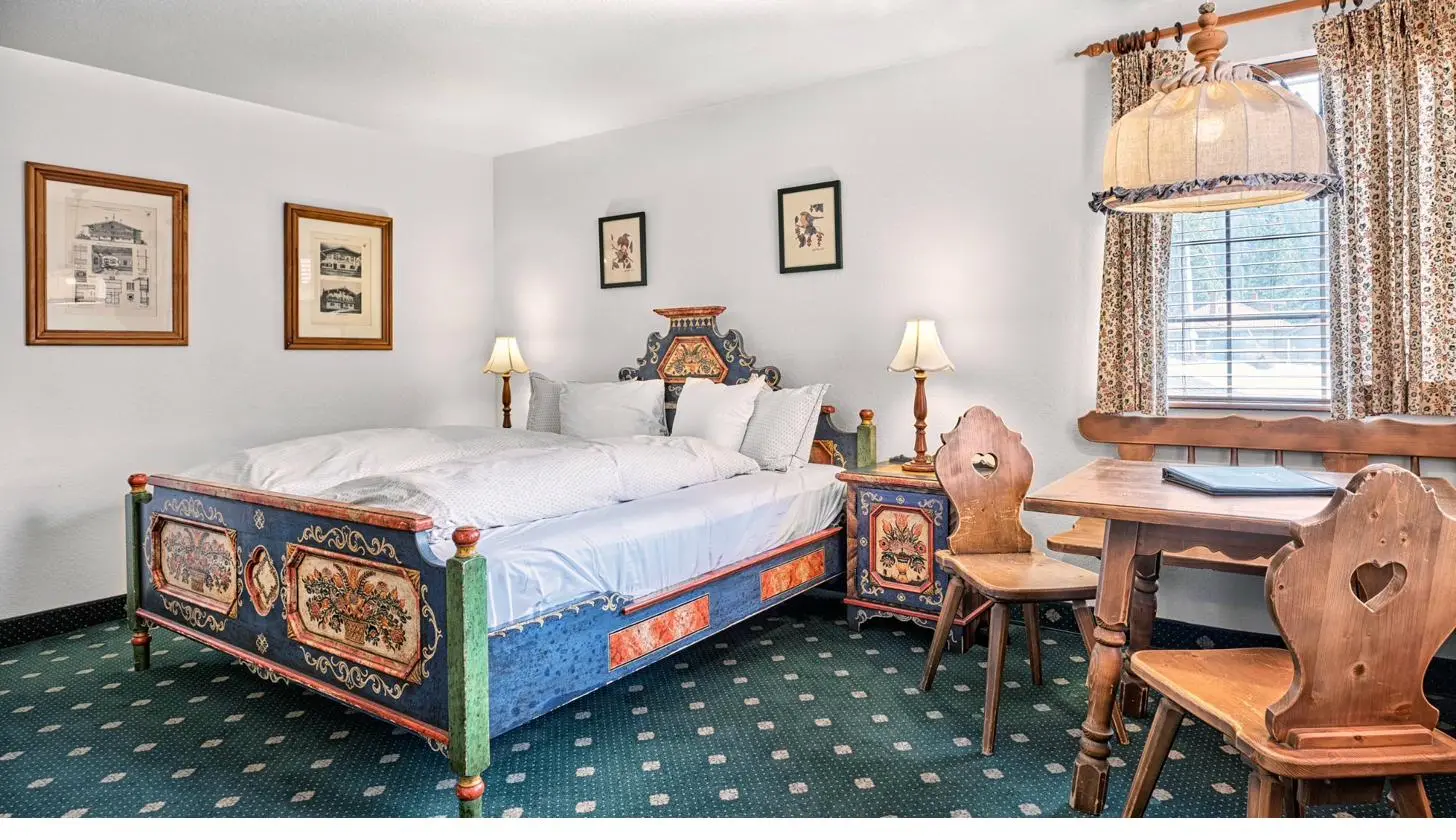
Cobalt blue ground, floral basket medallions on headboard and footboard, gold scrollwork borders, green-painted finials. The shaped crest rail with its painted cartouche is a signature of the Zillertal style, one of the most celebrated Bauernmalerei traditions in Tirol. The room also has a solid pine farm table and a pair of Herzlstühle: the heart-cutout chairs found in Alpine farmhouse kitchens from Bavaria to Salzburg. Built to outlast whatever sits next to them.
Pension Anna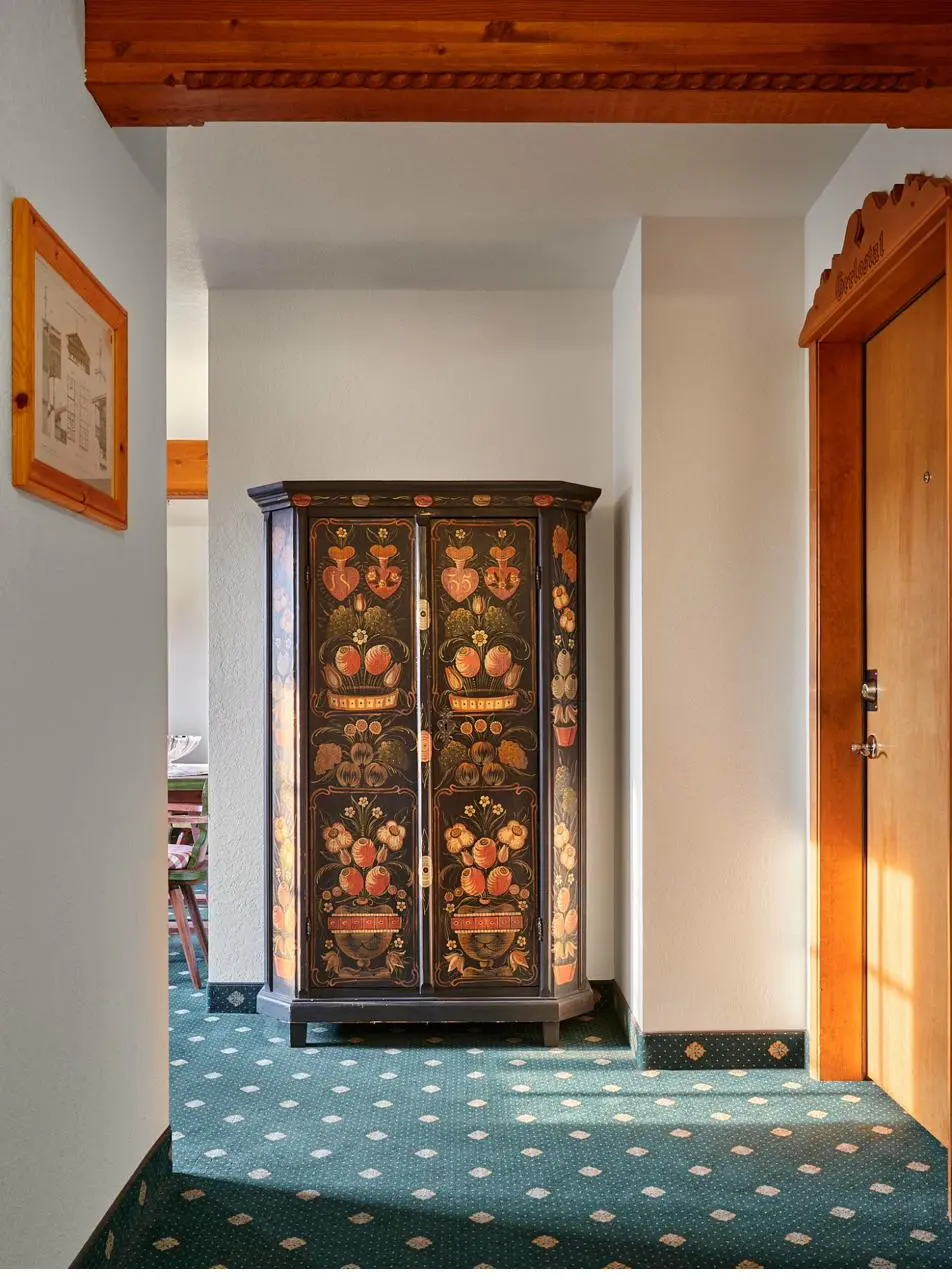
The near-black ground is the first thing you notice. Then the hearts and tulips, densely stacked and symmetrical on both doors, which are the hallmark of the Bad Tölz Schreinermeister tradition. Bad Tölz was one of the most distinct furniture-making centers in Upper Bavaria, and the chamfered corners with butterfly and floral panels are characteristic of the form. The painted program here was done with the confidence of a workshop that had been making this piece, in this style, for generations.
Pension AnnaBauernmalerei (farmer's painting) is the decorative tradition that runs through almost everything you see at Pension Anna. From the 17th century onward, Alpine craftsmen painted furniture, walls, and household objects with floral motifs, religious imagery, hearts, birds, and geometric borders, using earth pigments mixed in their own workshops. Every valley developed its own palette and vocabulary. A trained eye can tell the Zillertal from Bad Tölz from Berchtesgaden just by looking at the colors and motifs. The pieces throughout Pension Anna are a good place to look. Walk the hallways, linger over breakfast, spend time in your room. The differences are there if you look for them.
Seen throughout Pension AnnaThe Alps have spruce and pine. What they don't have in abundance is walnut, cherry, or oak. Hardwoods were expensive to bring into the valleys, and most families couldn't afford them. So Alpine craftsmen worked with what they had: Kiefer (Scots pine) and Fichte (spruce), soft and light, and they made it beautiful.
Part of how they did it was Maserierung (false graining): painting the surfaces of soft wood to simulate the grain of more expensive hardwoods. The sides and backs of Truhen were often done this way: a skilled craftsman could paint pine to look like walnut or oak using layered glazes and combing techniques. It was a genuine craft in its own right, not a shortcut. Only the wealthier households in towns could afford furniture made from imported hardwoods. The painted alpine furniture you see here tells you something about who made it and where they lived.
The lobby Truhe is a good example of this tradition carried forward. Bob Smith, who built Pension Anna, studied how these chests were constructed and painted one himself. He applied the false graining on the chest body. His friend and artist Jackie Cowan studied the Zillertal flower-painting style and painted the decorative panels. The result is a piece made in the same way the originals were, by people who learned the craft in order to do it properly.
Lobby Truhe · Throughout the Collection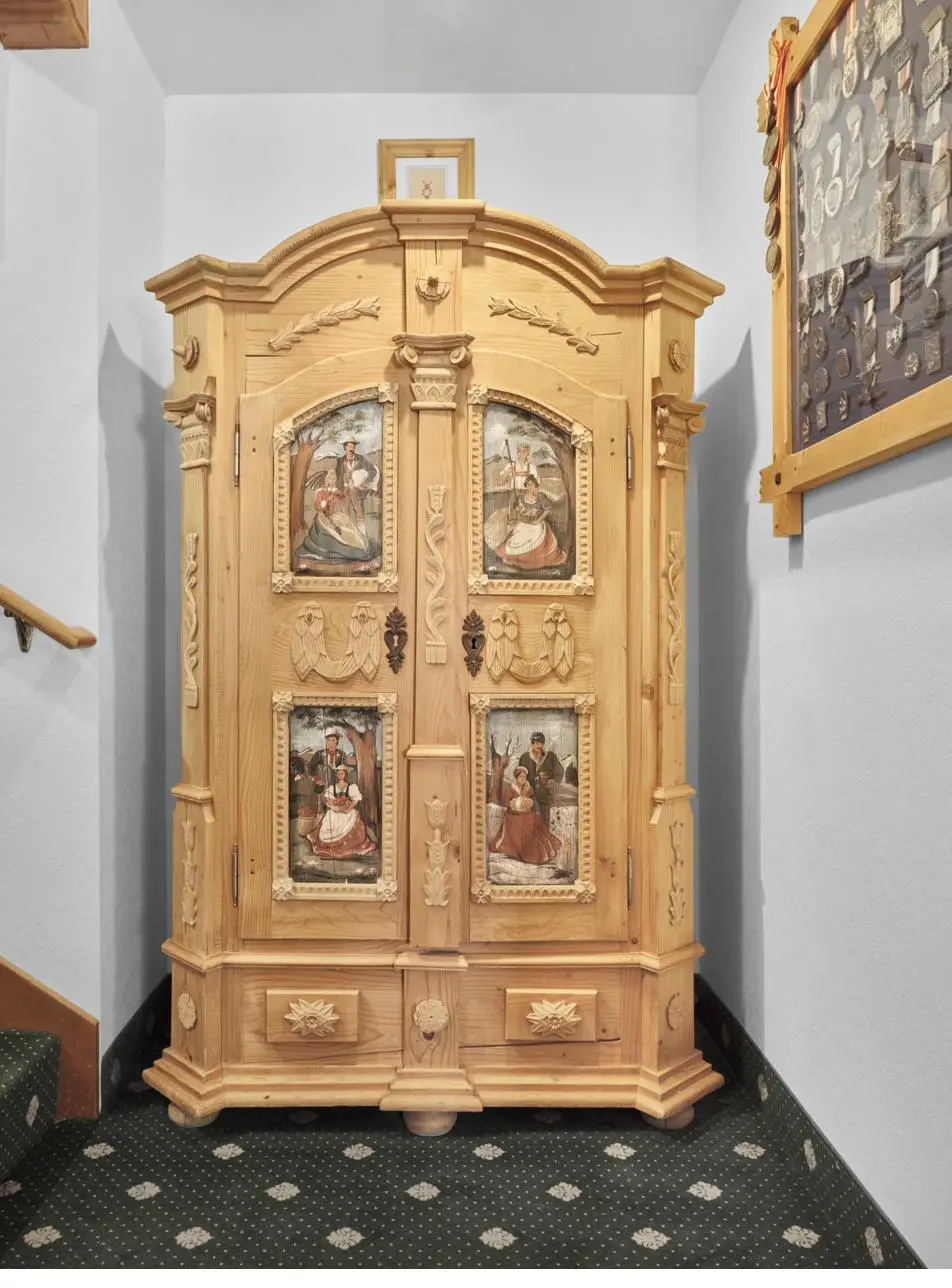
A large wardrobe in natural pine, carved and painted in the tradition of the Alpine Schreinermeisters. The four door panels show the seasons as courting couples in regional Tracht, a program rooted in 18th-century Baroque cabinet-making. The rope-twist columns, acanthus sprays, wheat sheaves, and edelweiss rosette drawer pulls are carved, not applied. A piece like this takes time. You can see where the time went.
Pension Anna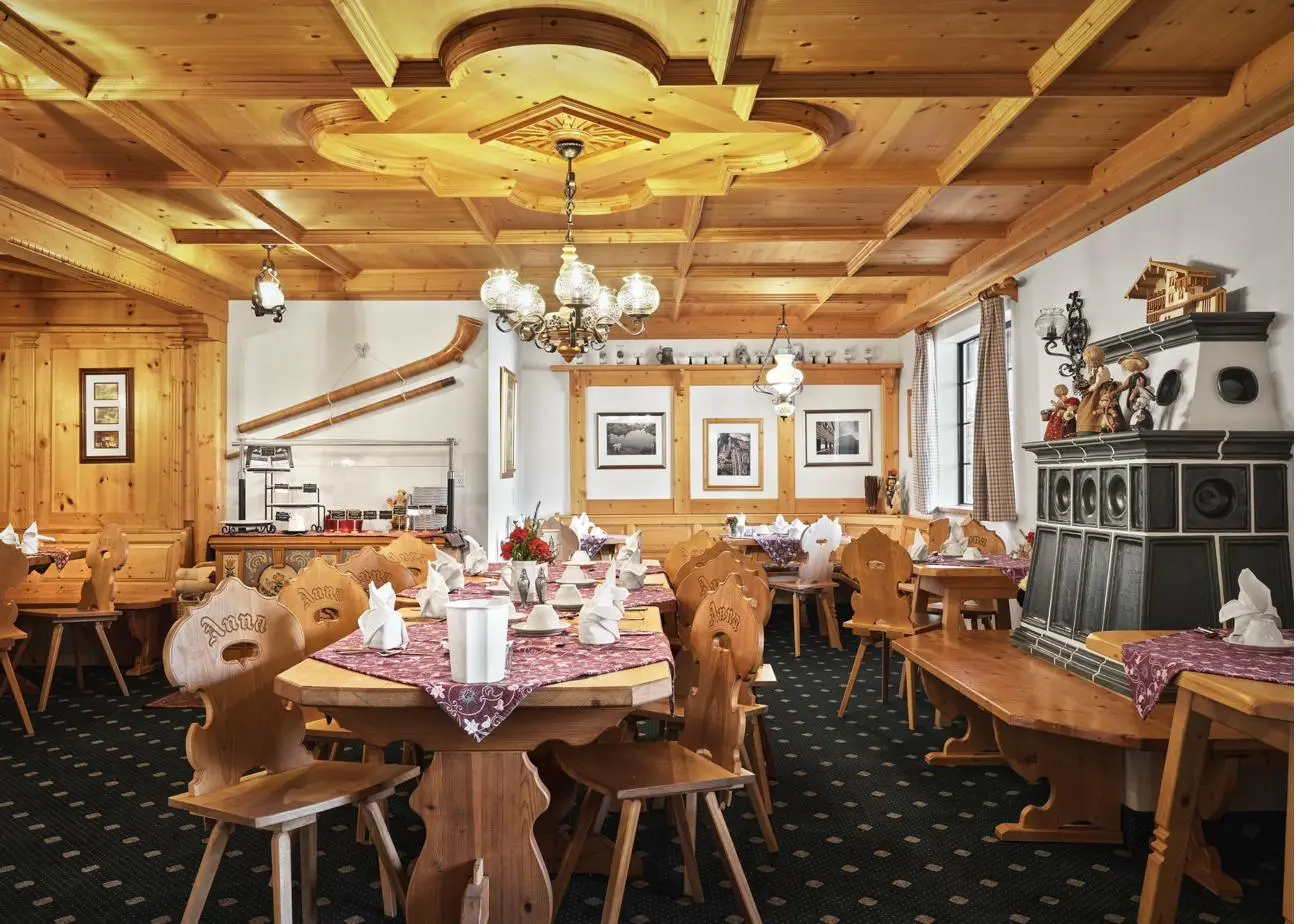
Bob Smith designed and built the entire interior himself: the coffered pine ceiling with its carved central rosette, the full wall paneling with raised framed sections, the fluted pilasters, the built-in Stammtisch corner nook with its integrated bench seating. Everything was made in his woodshop. Nothing bought ready-made. The Kachelofen in the corner was built in the same tradition: its ceramic tiles warm gradually with electric heat in winter, so you can pull your chair close and feel exactly what those farmhouse rooms were built around. Breakfast is served there every morning, and if you sit long enough, you'll understand why the Stube was always the heart of the house.
In a Bavarian or Tirolean farmhouse, the Stube (sitting room) was the room everything else organized around. A Kachelofen (tiled ceramic stove) dominated one wall, its mass absorbing heat and radiating it slowly through the night long after the fire had gone out. In the corner, the Stammtisch: the regulars' table, where the same people sat in the same seats for years. Not a formal dining room. A room that knew you.
Pension Anna Breakfast RoomNot all of the furniture at Pension Anna came from Alpine farmhouses. The Ottman Suite and the Alte Kapelle building are furnished in a different tradition entirely: the formal walnut style of prosperous German and Austrian households in the Gründerzeit era, the decades of rapid economic growth following German unification in 1871.
Where Bauernmöbel was made by valley craftsmen for working families, Gründerzeit furniture was commissioned by a rising urban bourgeoisie with money to spend and a desire to show it. The style they chose — Renaissance Revival, heavily carved walnut, marble tops, original bronze hardware — looked deliberately backward, borrowing the visual language of the 16th century to signal permanence and respectability. It was the opposite impulse from Bauernmöbel in almost every way.
The two traditions coexisted in the same era. They ended up in the same hotel.
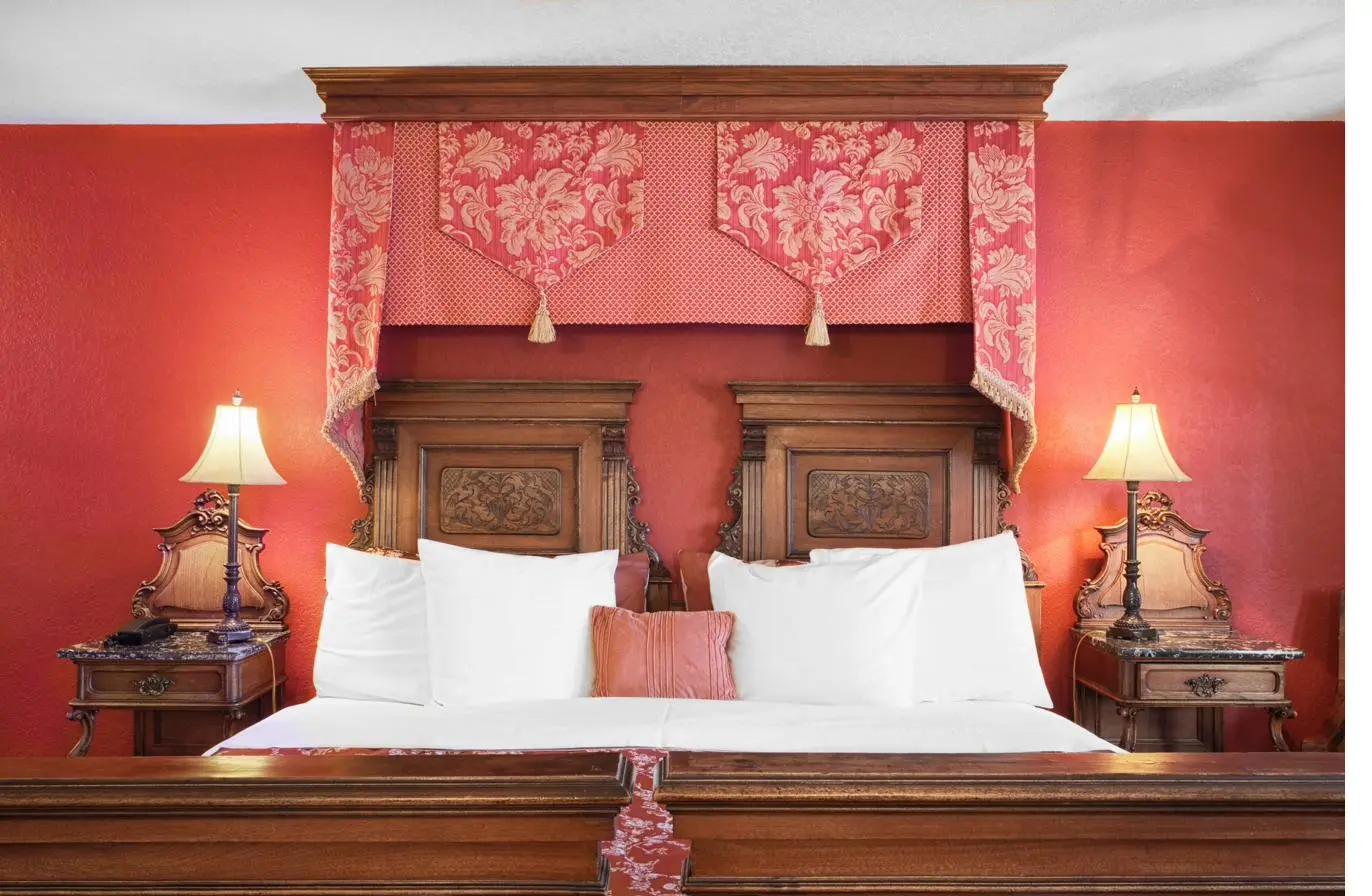
The Ottman Suite is one example: an antique Austrian carved walnut king bed, matching nightstands with marble tops and original brass hardware — a commissioned suite, not assembled from parts. The same tradition carries through the Alte Kapelle building, where both the Alte Kapelle Suite and the Pfaffenwinkl are furnished with antique walnut pieces imported from Austria. The same era, the same impulse, three different rooms.
Pension Anna · Ottman Suite, Alte Kapelle, PfaffenwinklThe furniture here came from the places it belongs to. Anne and Bob Smith made that decision when they built the hotel. Erika and Martin made it again when they added the Landhaus Truhen. It has never been reconsidered.
The ceremonial pieces at Landhaus Erika belong to the same Alpine tradition as the Truhen. Two objects worth knowing before you see the chests.
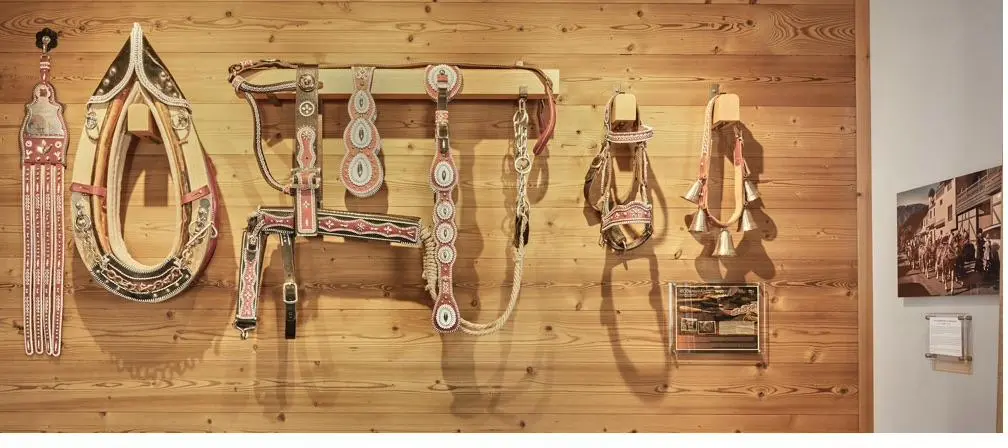
A complete ceremonial harness for the Haflinger, the golden Tirolean horse bred for Alpine terrain, used in festival processions for centuries. Collar, breast collar, halter, lead hardware: all in the red, white, and brass palette of the Bavarian and Tirolean procession tradition. The oval rosette medallions, white braid trim, and stamped leather panels are handmade, the work of a Sattler whose methods haven't changed since the 19th century. At the Leonhardiritt and Oktoberfest, horses still wear harnesses like this one.
Landhaus Erika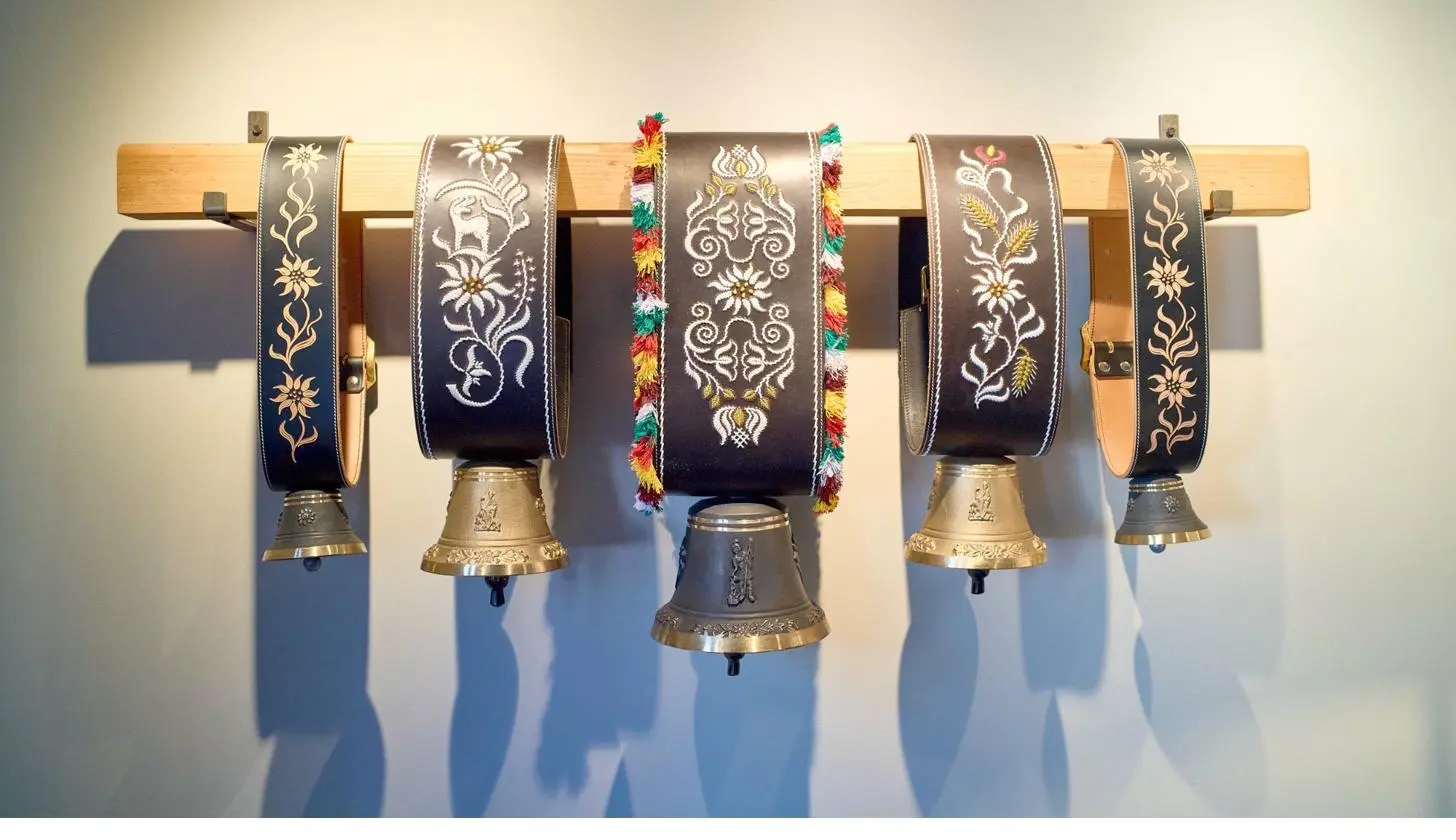
Five cast-brass Glocken, each on a hand-embroidered leather Riemen with its own decorative program: edelweiss, chamois, wheat sheaves, baroque floral scrollwork, wool tassel fringe. The bells are foundry-cast with relief Alpine scenes and saint figures, from small Tirolean foundries whose process is unchanged in two centuries. At the Almabtrieb, the annual descent of cattle from the high summer pastures, the lead animals wear bells like these. The sound carries down the valley before you can see the herd.
Landhaus Erika · Spring Suite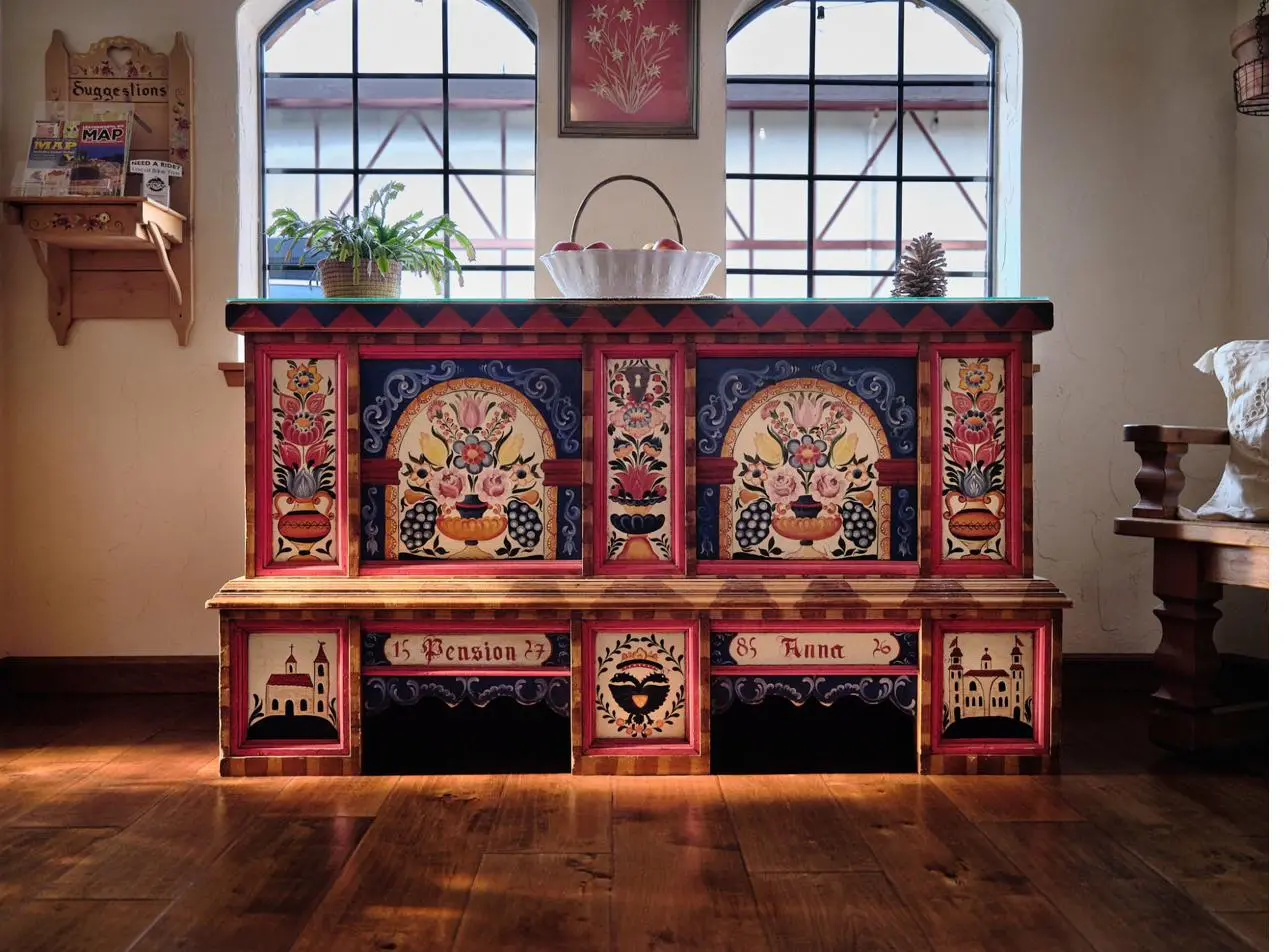
A Truhe is a chest, but in Bavaria and Tirol it was much more than that. For centuries it was the most important piece of furniture a family owned. When a woman married, she brought her Truhe with her: packed with linen, dowry goods, documents, the things that mattered. It was often the only piece of furniture that truly belonged to her. Passed down, not discarded.
The finest Truhen were painted: regional floral motifs, religious imagery, hearts, birds, geometric borders. Red, blue, green, gold. Every valley had its own style; the Zillertal looks different from the Alpbachtal, which looks different from the Tuxertal. You can learn to read them.
The chest you see when you walk into the lobby is the introduction. It was commissioned for Pension Anna, and the hotel's name is painted across the front, with a crowned heart at center and church silhouettes at the base corners. Arched floral panels, baroque scrollwork, the full vocabulary of the tradition. Most guests stop in front of it before they've even checked in.
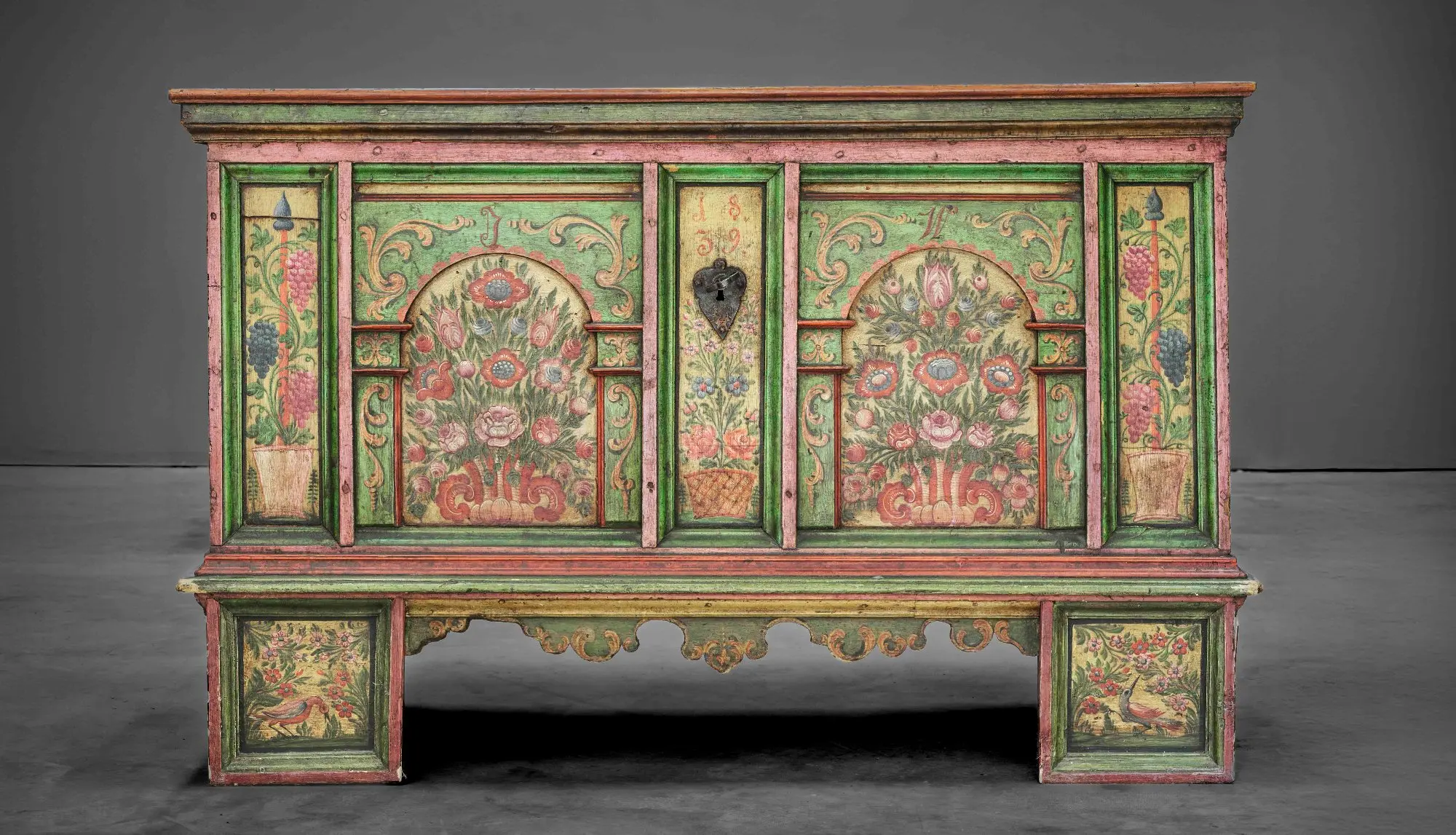
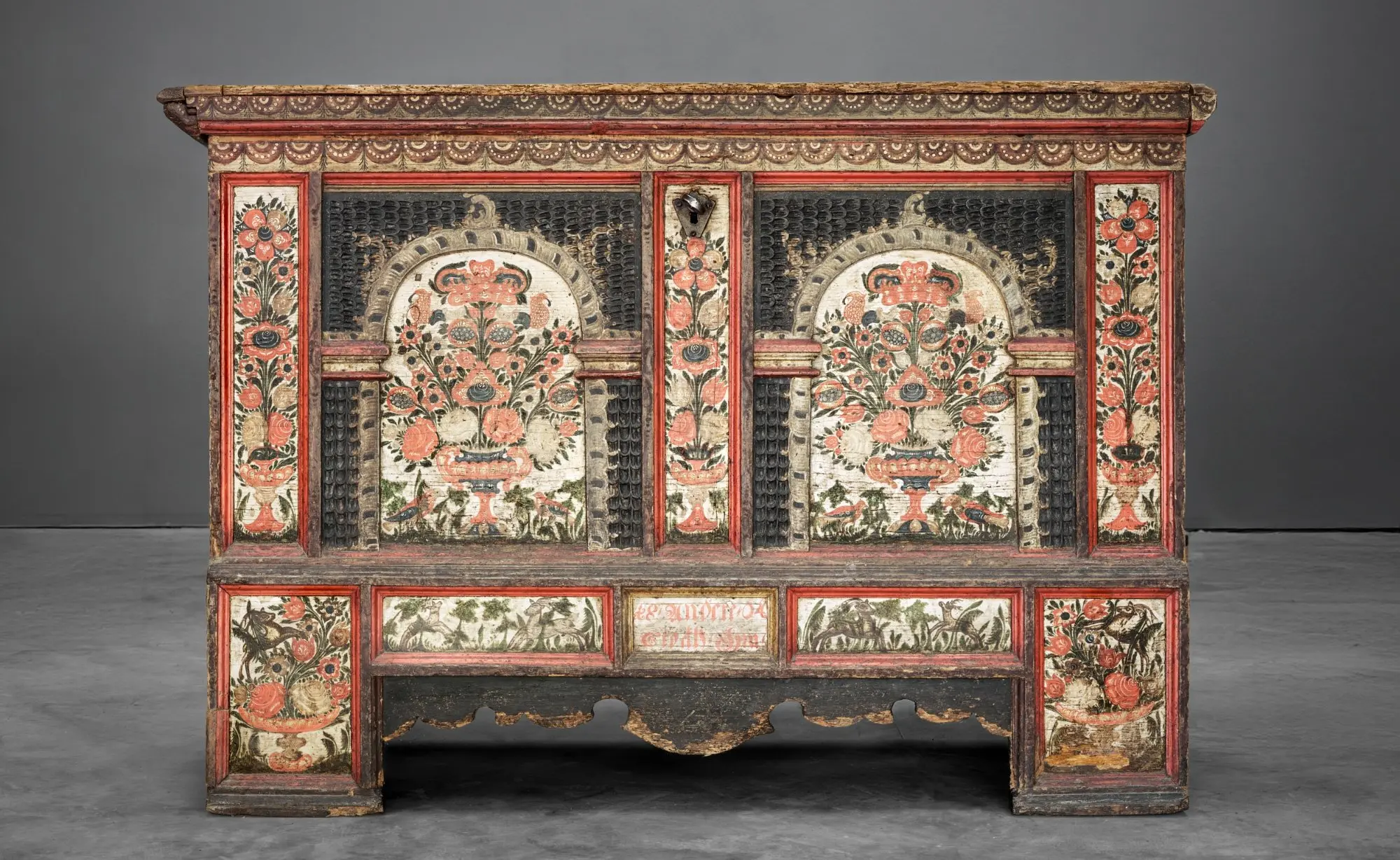
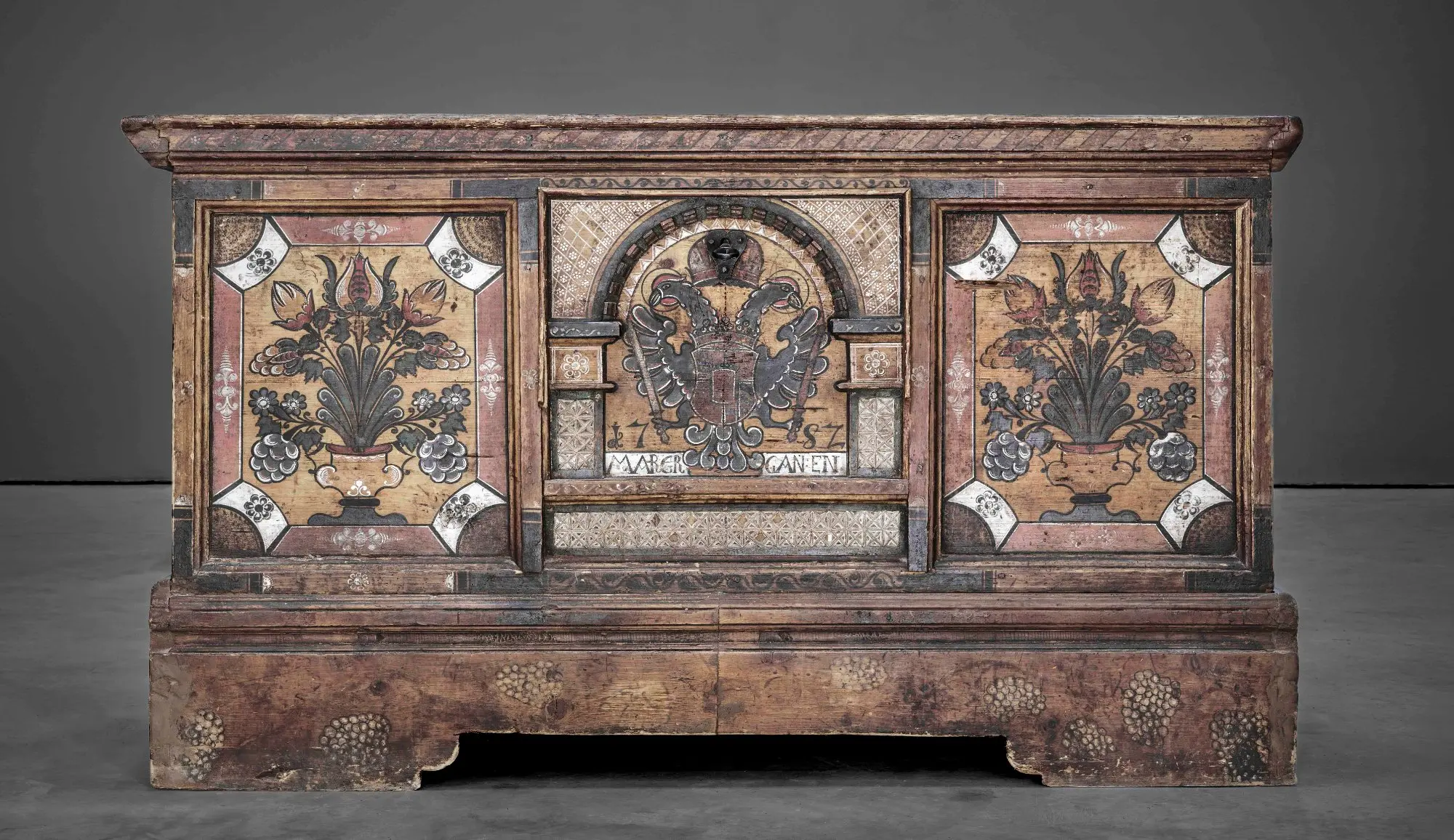
The five Truhen in the Landhaus Erika suites go further. Each one is a genuine antique: an original 18th or 19th century piece sourced from the valleys of Tirol, dated, named, irreplaceable. They're at the foot of your bed.
Five suites, five Truhen. Each one is a genuine antique from the valleys of Tirol: original painted surface, original hardware, original age. None of them were made to be decorative. They were made to last, and they have.
 Tap for details
 Tap for details
 Tap for details
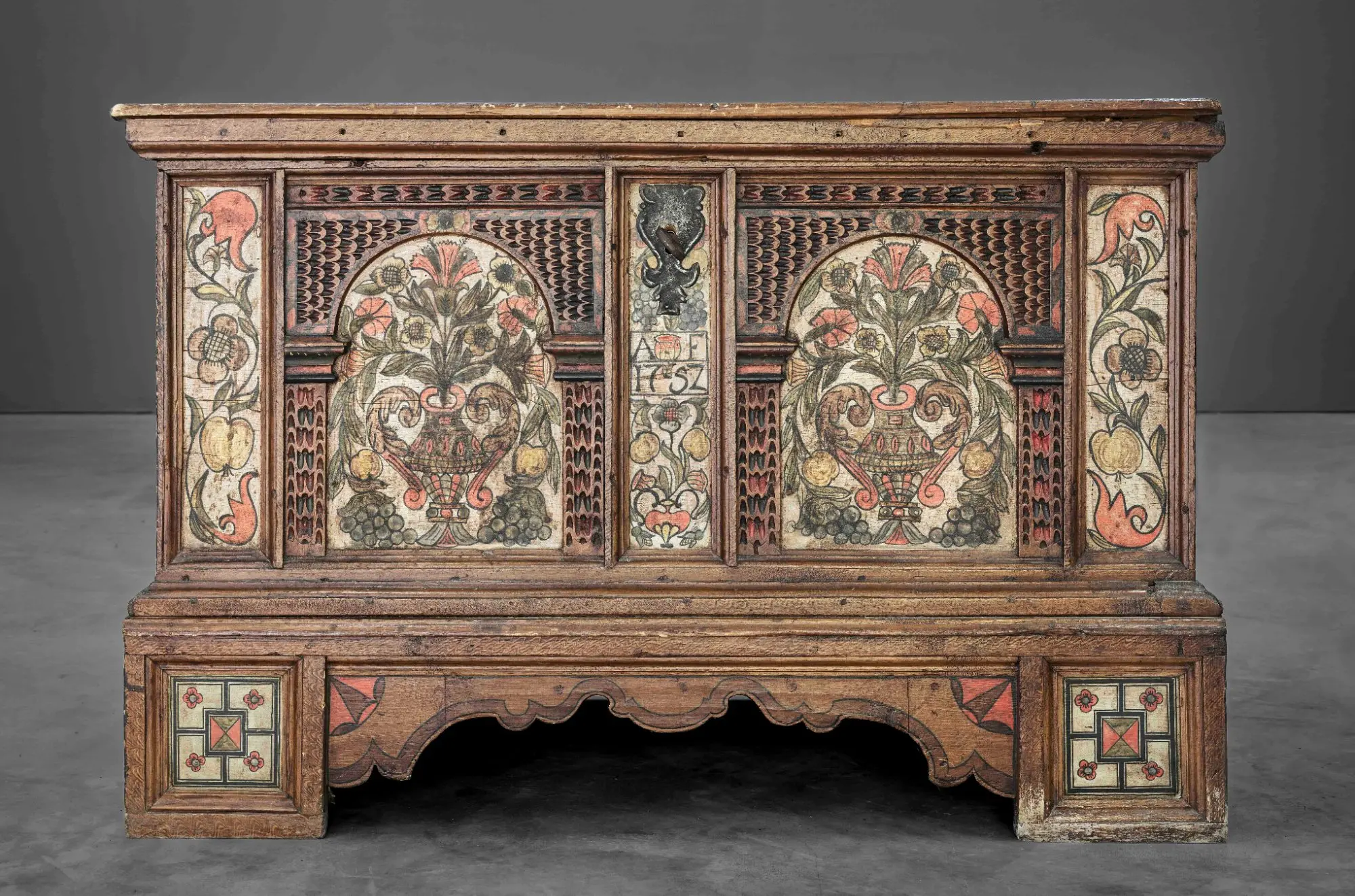 Tap for details
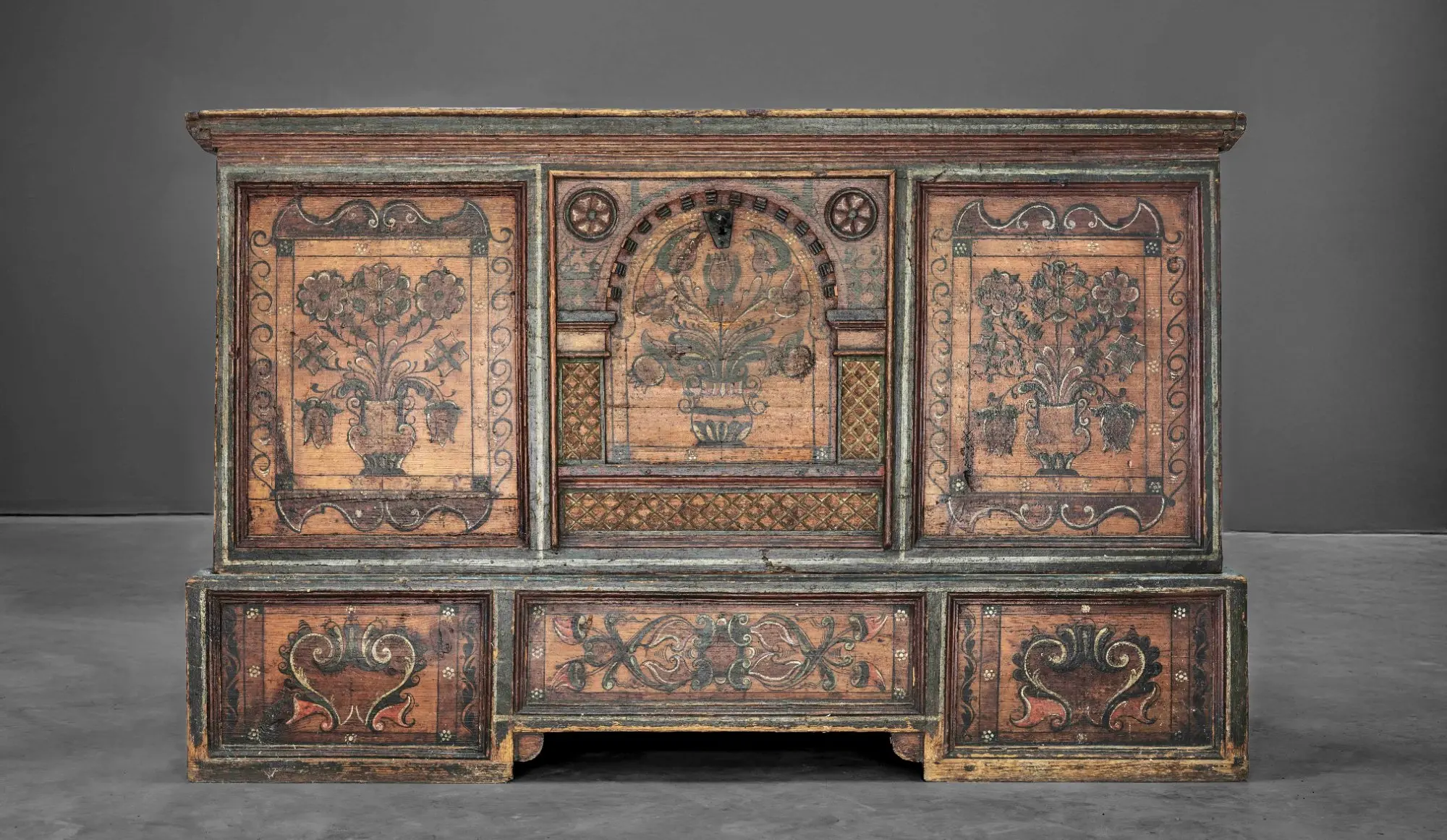 Tap for details
"Every Truhe in Landhaus Erika has a date painted on it. The oldest is 1742. Someone made it, someone owned it, someone carried it. Now you can sleep next to it."— Martin Szuster
You have to stay here to see it properly. In the morning light, over breakfast, with time to look. That's the point.
View the RoomsA Truhe is a painted wooden chest, but in Bavaria and Tirol it was the most important piece of furniture a family owned. When a woman married, she brought her Truhe with her: filled with linen, documents, and the things that mattered most. The finest examples were painted by craftsmen who worked within one valley tradition their whole lives. Zillertal, Alpbachtal, Tuxertal: each region's chests look distinct, and you can learn to tell them apart. The five Truhen in the Landhaus Erika suites are original 18th and 19th century pieces sourced from those valleys. The oldest dates to 1742.
Bauernmöbel literally means "farmer's furniture" — the painted and carved furniture made by Alpine craftsmen for the families who lived in the valleys of Bavaria and Tirol. Mostly Scots pine and spruce, painted with floral motifs, religious imagery, hearts, and geometric borders using earth pigments. Every valley developed its own palette and decorative vocabulary, so a piece from Bad Tölz looks nothing like one from the Zillertal. The furniture throughout Pension Anna is authentic regional Bauernmöbel, collected by the hotel's founders Anne and Bob Smith over years of traveling and living in Bavaria and Tirol.
Yes. The Truhen in the Landhaus Erika suites are genuine antiques: original 18th and 19th century pieces sourced directly from the valleys of Tirol, with original painted surfaces, original hardware, and documented dates. The Bauernmöbel throughout Pension Anna's rooms is authentic traditional craft — the same forms, techniques, and materials Alpine craftsmen have used for generations — collected and imported by the founders who knew what they were looking for.
The oldest Truhe in the Landhaus Erika collection dates to 1742 and sits in the Solstice Suite. The Spring Suite chest is dated 1839, the Summer Suite 1804, the Autumn Suite 1782, and the Winter Suite 1752. Several of the painted pieces in the main Pension Anna building date to the late 19th century.
Anne and Bob Smith, who built Pension Anna in 1989, spent years living and traveling in Bavaria and Tirol before opening the hotel. That experience gave them the knowledge to source the real thing: they knew the regional traditions, knew what to look for, and imported the furniture directly. When Erika and Martin became owners in 2018, they continued that standard, adding the antique Truhen for Landhaus Erika from the same Alpine valleys.
It goes considerably deeper. Most hotels in Leavenworth have Bavarian-styled architecture on the outside and standard hotel interiors on the inside. At Pension Anna, the furniture, the painted walls, the carved ceilings, the tiled Kachelofen in the breakfast room, and the antique Truhen at the foot of your bed are all the genuine article. The breakfast room was designed and built by Bob Smith himself, modeled on a traditional Alpine Stube. The Landhaus Erika suites were furnished with original 18th and 19th century pieces from Tirol. The outside and inside match.
Pension Anna's rooms are furnished with traditional Bauernmöbel — authentic regional Alpine furniture made in historical craft traditions, collected and imported by the founders. These are not antiques in most cases, but they are the real craft. Landhaus Erika goes further: each of the five suites contains a genuine antique Truhe, an original painted chest from an 18th or 19th century Tirolean household. These are irreplaceable pieces. The Bauernmöbel at Pension Anna tells you about the tradition; the Truhen at Landhaus Erika are primary sources.
All five Landhaus Erika suites: Spring Suite (Zillertal, 1839), Summer Suite (Zillertal, 1804), Autumn Suite (Alpbachtal, 1782), Winter Room (Tuxertal, 1752), and Solstice Suite (Alpbachtal, 1742). Each chest sits at the foot of the bed.
The furniture and antiques run throughout the whole property. Painted pieces, carved Schränke, and decorative objects appear in the hallways and common areas of Pension Anna, not just behind room doors. The lobby Truhe is worth stopping at before you even check in — the hotel's name is painted across the front in the full Bauernmalerei tradition. The breakfast room is itself a piece of the collection: coffered pine ceiling, carved rosette, Stammtisch corner nook, and a traditional Kachelofen, all built by hand by Bob Smith. Give yourself time to look around. There's more here than most guests catch on a single stay.